Tapping 101

About EFT Tapping
EFT Tapping is a therapeutic technique that has been widely studied by researchers over the past two decades. At its core, EFT involves tapping on specific acupressure points on the body while focusing on a particular issue or emotion.
Over the past two decades, 300+ peer-reviewed publications have examined EFT, including 50+ randomized controlled trials and several meta-analyses in medical and psychology journals. A collection of these studies can be accessed below.
This process is believed to stimulate the body's energy meridians, helping to release blockages and restore optimal physiological function. Research has explored EFT’s effectiveness in reducing symptoms of anxiety, depression, PTSD, and a variety of other physical and emotional conditions.
The technique is also thought to activate the parasympathetic nervous system, promoting relaxation and supporting the body's natural healing processes. As a result, EFT is increasingly recognized as a safe, drug-free approach that many people use to support emotional well-being and personal growth.
History of EFT (origin and development)

EFT tapping began gaining popularity in the 1990s thanks to Gary Craig (1940–2026). With a background as a Stanford trained engineer and personal performance coach, Gary recognized significant potential in Roger Callahan’s Thought Field Therapy (TFT). Although TFT was highly effective, it involved intricate tapping sequences that were difficult for many people to follow.
Determined to make this powerful method more accessible, Gary simplified the process, leading to the creation of EFT tapping. The technique blends elements of ancient Chinese acupressure with modern psychology, making it both easy to learn and highly effective. Many experienced remarkable relief from emotional issues in far less time than with conventional therapy. The method continued to spread worldwide, transforming the way many approached emotional healing.
He named the process Emotional Freedom Techniques (EFT), and several million people downloaded his original book, The EFT Manual. That book was later updated and expanded into The Gold Standard EFT Tapping Tutorial, which remains available in his materials.
Over time, he observed that clearing emotional distress with EFT often coincided with reductions, and in some cases elimination, of physical pain, disease, and ailments without the use of drugs, surgery, radiation, or other conventional medical interventions. Addressing emotional contributors through EFT produced meaningful healing outcomes for people around the world.
Today, EFT tapping is used globally by both alternative health practitioners and mainstream psychologists. Research has demonstrated its effectiveness in addressing anxiety, PTSD, chronic pain, and phobias. Its simplicity and versatility make it an accessible tool for those seeking emotional wellbeing and personal growth.

Introduction to Tapping Points
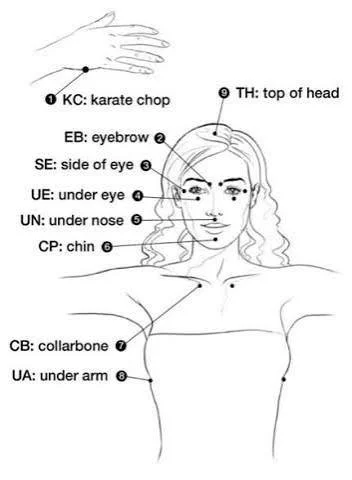
Top of Head (TH)
Directly on the crown of your head.
Eyebrow Point (EB)
Where the eyebrows begin, closest to the bridge of the nose.
Side of Eye (SE)
On the bone directly along the outside of either eye.
Under Eye (UE)
On the bone directly under either eye.
Under Nose (UN)
The area directly beneath the nose and above the upper lip.
Chin Point (CP)
This is the area just below your bottom lip and above the chin, right in the crease.
Collarbone Point (CB)
Starting from where your collar bones meet in the center, go down an inch and out an inch on either side.
Under Arm (UA)
On your side, about four inches beneath the armpit.
Scientific Research on EFT Tapping
Over the past two decades, a growing body of scientific research has examined Emotional Freedom Techniques (EFT), including 300+ peer-reviewed publications, more than 50 randomized controlled trials, and several meta-analyses published in medical and psychology journals. These studies have explored EFT’s effects on anxiety, PTSD, depression, stress, physical pain, and other emotional and physiological conditions.
Many of these studies are indexed in PubMed, the research database of the U.S. National Library of Medicine.
Two researchers who have contributed significantly to the scientific study of EFT include:
Dr. Peta Stapleton
Professor of Psychology at Bond University and one of the most published researchers studying Clinical EFT. Her work has explored EFT’s effects on anxiety, trauma, food cravings, and physiological markers such as cortisol.
Dr. Dawson Church
Researcher and author who has led and compiled numerous studies on Clinical EFT, examining areas such as stress reduction, emotional regulation, and neurobiological mechanisms.
If you’re interested in exploring the research further, you can visit the resources below.
PubMed – EFT Research Studies
https://pubmed.ncbi.nlm.nih.gov/?term=emotional+freedom+techniques
Bond University – Dr. Peta Stapleton Research Profile
https://research.bond.edu.au/en/persons/peta-stapleton/
Evidence-Based EFT Research Library
https://eftuniverse.com/research-studies/